
Today, the VDAs run as virtual instances on the hypervisor, generously equipped with vRAM, and Windows itself has become much more frugal than the Windows 7 of yesteryear. So, Do I still need all this optimization fuss?
The short answer: Most of it, no. But one thing, yes—and it's non-negotiable.
The one optimization that really counts
If one honestly goes through the long list that an optimizer offers, remarkably little remains in the provisioning context that one compelling must be set. Much is a matter of taste, compliance, or simply micro-optimization without a measurable effect.
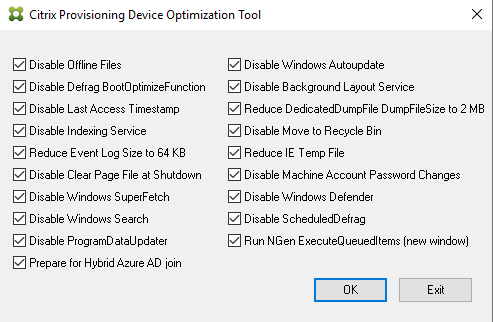
One setting, however, is different. It's not a performance question, but a Stability and Correctness Question, the deactivation of the automatic Computer account password change I'm in the image.
Why her, specifically? Windows rotates the machine password at regular intervals. On a normal machine, this is not a problem. On a non-persistent image, it becomes a trap:
- Windows changes the password and dutifully updates the status in Active Directory.
- The new local secret lands in the volatile write cache.
- On the next reboot, this cache will be discarded. The target will revert to the old password from the image.
- AD and Target now have different passwords — the classic „trust relationship failed“.
This is why this one setting in the image must be disabled. PVS itself takes over password rotation centrally and consistently from the infrastructure – which, by the way, also runs more reliably than the local Windows mechanism. This is the optimization in provisioning that truly makes the difference between „it works“ and „it breaks eventually.“.
Why the remainder stays with the admin
Everything else that the optimizer templates offer is exactly that: an offer. And it consciously not Automatically setting it is not a convenience, but an attitude.
Because the environments are different:
- Some customers want maximum optimization for highest density.
- Others must run as close to a standard, unmodified Windows as possible for compliance reasons.
- Others already come with their own, optimized base image and do not want a tool to overwrite it.
- And in some corporations, telemetry simply cannot be turned off.
A blanket optimization would lump all these cases together. That's precisely the flaw of old tool collections: they know rules, but not context.
Optimization without understanding is dangerous
And here's where it gets tricky: Blind optimization is riskier than no optimization at all.
A frequently cited example: a standard optimizer disables the Disk Cleanup service — sounds harmless. However, FSLogix needs exactly this service for compacting profile containers. A well-intentioned optimization has thus created a problem elsewhere. And because this happens on the master target — a virtual template from which all workers are created — every single VDA inherits it.
This is why optimization can only be correct within the context of the specific environment. What makes sense on one farm can be a boat problem on the next.
The honest answer
Do I still need Citrix PVS optimization?
- The hundred tweaks from the template, applied across the board? No. That's largely a relic – and in doubt, dangerous, because you break dependencies that you don't oversee.
- The one setting that is absolutely correct in provisioning—the disabled password change? Absolutely. It must be done, always.
The discipline has shifted: away from „disable as much as possible,“ towards „doing exactly the one thing that is proven to matter — and consciously leaving the rest to the admin, who knows their environment.“.
Optimization 2026 is no longer a massacre. It's a single, precise cut. Those who understand this optimize less — and gain more stability.
This very philosophy is at the heart of PVS Forge: As a built-in measure, only what is absolutely essential for provisioning is set – the disabling of the computer account password change. Any further optimization remains optional